Ben brings way too much research to the table — literally — as he and Pete sit down to discuss a format-breaking episode of the Muppet Show, but one where Steve adapts his previously-established act for the family-friendly audience. And, it turns out, some of that act hasn’t aged well, but that may be less problematic than Pete and Ben running afoul of the Italian-American Anti-Defamation League!
Sources and References:
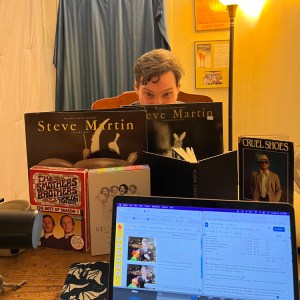
Born Standing Up provided the bulk of the source for Ben’s research on Steve Martin, but — as implied in the blurb for the episode, and references in the audio — he also listened to Martin’s albums, reviewed some of his stand-up specials, and his early appearances as a writer-performer on The Smothers Brothers Comedy Hour.
Martin’s version of “Happy Feet” can be compared to the more traditional Muppet version. While Judy Collins did appear on The Smothers Brothers‘ variety show, Ben was able to find no indication that she and Martin interacted at that time. The anecdote about Mitzi Trumbo is recounted in the section of Martin’s memoir excerpted here in The New Yorker. Elvis’s comment “Son, you have an ob-leek sense of humor.” is quoted in Janet Maslin’s New York Times review of Born Standing Up, but he did not call Martin’s act “anti-comedy”, a phrase which has gone on to have a much wider scope. And the riff, “I was born a poor Black child…” that becomes the entry point to the feature film The Jerk can be found midway through side-B of the Let’s Get Small album.
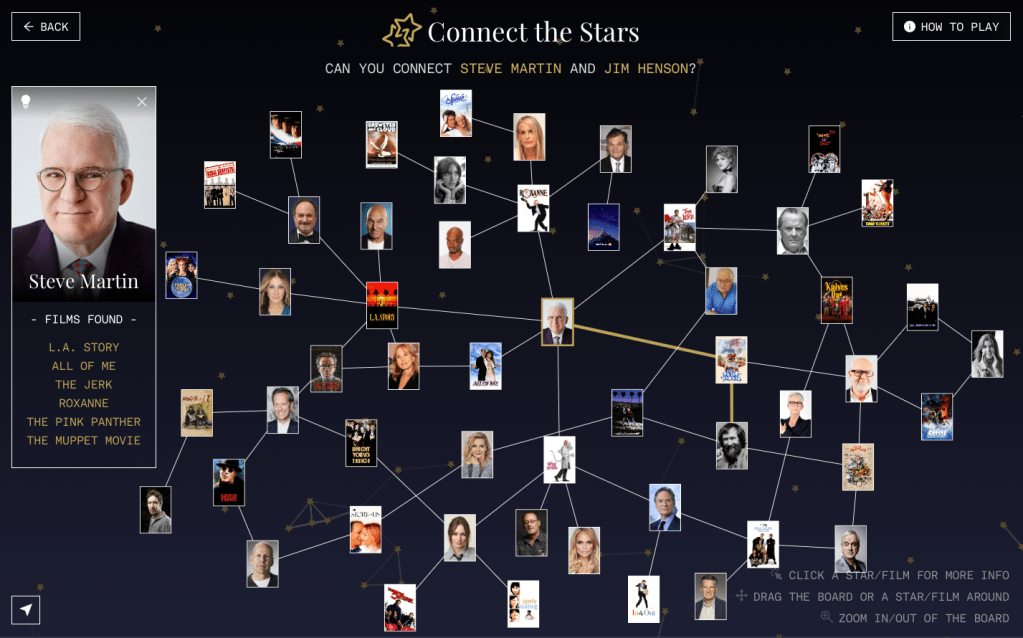
The strings of connectivity between Steve Martin and Jim Henson through his Top 4 on IMDB, as depicted on Connect The Stars, looks a little like this:
Pete says that Martin using the catchphrase “Excuuuuuuse ME!” on The Muppet Show is reverting to his “classic phrase”. It’s interesting to use Martin’s appearances on Saturday Night Live to track the omnipresence of the phrase, an how much of a “catchphrase” it really is. The phrase is used as the capper for a bit of faux-outrage. Martin had done this in response to a cameraman not doing a close-up of him playing the banjo on the second season of SNL on October 23, 1976 (07:30 to 8:05), and then does it again a week later in his HBO special, “On Location”, filmed at the Troubador on October 31, 1976. Martin requests a spotlight, doesn’t get it, goes into a diatribe about how he can’t count on professionals to do what’s expected of him. This is also recorded as part of his act on Let’s Get Small, which was released, according to a webpage tracking albums going gold and platinum, in September of 1977. Martin has two more appearances on SNL between his use of the bit for that audience and his album becoming available to the general public, the first on Feb. 1977, he says “Excuse me,” three times in his opening monologue without invoking that inflection at all, and when he opens the third season of SNL on Sept. 24, 1977, he mentions the album is about to come out. For the aforementioned Music Awards website to be right, the album comes out within the next week, meaning it’s been out for a month before anyone watching a CBS affiliate has a chance to see him say it on The Muppet Show. Is it a classic phrase by that point? Well, consider Martin’s subsequent appearance on SNL in January of ’78, where he ends his monologue with a call-out to that phrase, to wild audience response. Pete’s analysis that he’s aware it’s going to become a thing seems spot on, which makes it more amusing to contrast the SNL ’78 response to the tiny giggles of the in-house Muppet audience.
Ben checked his sources to see why he might have done earlier research on the can-can, and the only thing he can come up with is a potentially amusing coincidence. While Wikipedia says that the traditional can-can music comes from the opera Orpheus in Hell, it does not mention that the tune is called “The Gallop Inferno”, which seems to be limited to a flashcard in a Quizlet page of dubious prominence. What makes this amusing is that name is astonishingly adjacent to “The Devil’s Gallop”, which is the theme song used by Sir Digby Chicken Caesar in The Mitchell and Webb Look.
Ben’s belief that the giant balloon in Martin’s act could have been a reference to The Prisoner can’t be proven, but the Prisoner Fandom page indicates that the episodes aired in the US on CBS in 1968, less than a year after the initial UK broadcast. This video is representative of the kind of balloon action that appeared on the show.
A few articles about the fiftieth anniversary of “Tie A Yellow Ribbon” mention the phenomenon of people believing it was part of a much longer tradition, and the Wikipedia entry on the Levine and Brown song contains the fairly staggering list of people who covered it in 1973.
The Tweet from the HelloCullen account that Pete referred to has been deleted — whether from attention from commenters and reply-guys or a general desire to no longer have content on a dying platform is anyone’s guess — and the John Oliver joke occurred in the introduction to his October 2, 2022 show. Ben makes reference to the Italian-American Anti-Defamation League, but apparently that specific organization hasn’t existed for some time. It must have been some other cultural heritage group protesting cultural slams — perhaps this one? — that he remembered hearing about in his lifetime.
 Farced Perspective