Ben and Pete look at the posthumous release of the Muppet Show episode featuring Zero Mostel, discussing his maximalist performance, dissecting the show’s spec script origins, and digressing into the depths of wordplay “betta” left unplumbed.
Sources and References:
Despite talking about how Jared Brown in Zero Mostel: a Biography, spends time on “almost every page” indicating that Mostel made up many stories or said things about himself that later couldn’t be verified, there’s a good chance that Ben didn’t read all of the book. Particularly considering his anecdote about Mostel refusing to testify in front of HUAC is the hook for Brown’s introduction, and the information about the amputation appears on the following page. Ben’s information about how Mostel’s family’s wished to not have any sort of public recognition could have come from Wikipedia, but it does also appear on page 307 of Brown’s book. And if Ben’s read on Brown’s observation that Mostel would say different stories at different times is true — that Mostel would go for the good line, regardless of what had actually happened — then people might misinterpret Mostel’s washcloth sentiments about the Muppets based on the primacy of this quote on his IMDb page. But beyond all that, his speculation that the Muppet Show staff might not have done any in memoriam credit because of these wishes is certainly all in Ben’s own fevered brain.
Information about Mostel’s contributions to the Du Barry Was a Lady soundtrack comes from its IMDb entry, where Ben was clearly very excited to discover there’s a song called “Madame, I Like Your Crêpe Suzettes“. Had Mostel been in the Broadway production, there instead would have been, no doubt, an Au Bon Pain joke about the song “L’Apres Midi d’un Boeuf” or even “Give Him the Ooh-La-La”!
There’s comparative very little about The Electric Company on the Muppet Fandom page, which — while it has a full episode page about seemingly every Sesame Street episode — doesn’t seem to have individual pages about regular Company features, not even the Spider-Man segment. So instead, there are multiple clips of “Letterman” to be found on YouTube, featuring Mostel as the villainous Spellbinder. Watch even a few and the formula becomes quickly apparent, as does the fact that Joan Rivers’ lively narration is the real star of the segment. Mostel’s entry in the Fandom Wiki highlights his pantomime contributions to the Sesame Street Book of Opposites, and video footage of Mostel performing facial expressions for those printed photographs can be found here.
Mostel’s top four on IMDb leads to this Connect The Stars chart:
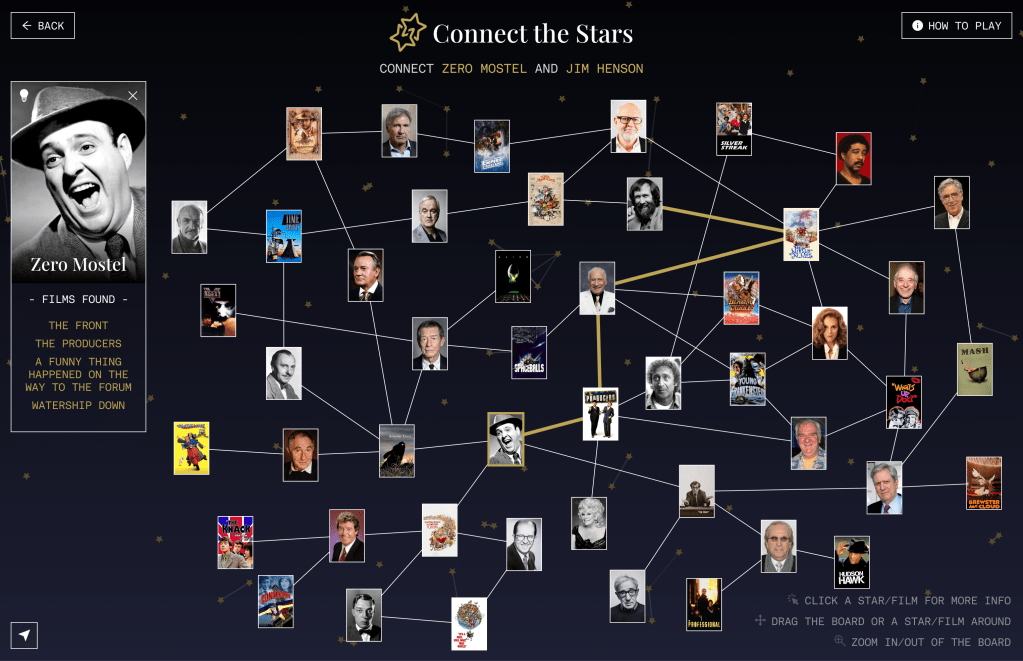
You’ll notice that Connect the Stars does NOT create a line between Wilder and The Muppet Movie because Ben is wrong in thinking he is one of the many celebrities to cameo in the film, but he is correct in saying that Wilder’s Silver Streak co-star Richard Pryor is a balloon salesman in The Muppet Movie and not, as Pete misremembers, in Muppets Take Manhattan.
Pete has a good time trying to distract and undercut Ben by “saying “correcting” him by saying operetta or Marietta whenever Ben says the alternate word. Ben is trying to give some context for the inclusion of the reference to Naughty Marietta, but specifically to the song “Ah! Sweet Mystery of Life”, which very much fits in with all the other overblown song titles that have populated this episode and its connected research. Despite lightly mocking Wikipedia’s assertion that the operetta “includes several well-known songs”, Ben is convinced that he somehow knows “Ah! Sweet Mystery…” or something in which it’s referred, but can’t place the connection. The most obvious reference is likely Young Frankenstein, where Madeline Khan bursts into tune with that particular number when overcome with ecstasy when first, ahem, fully encountering, ahem, the Monster. But there’s a chance it’s also referred to in The Goon Show. An old usenet post lists it as being sung by Harry Secombe during a Milligan-less episode that was unrecorded, and Secombe also performed the number in a less comic mode, so there’s a chance that it was referenced at other points in the series as well.
 Farced Perspective